
Posts Tagged ‘draw advantage’
Chester lowly drawn today
Saturday, May 26th, 2012We’ve discussed the low draw advantage at Chester a number of times in this blog. Comprehensive analysis of the advantage afforded by a low draw at Chester is also one of the examples covered in the Smartform User Manual.
Despite the number of times the low draw advantage is mentioned, it continues to produce a blind level stakes profit in certain circumstances (in particular sprints over the minimum distance with a decent field size on decent going). Now that the worst of the bad weather is over (and the Chester May meeting is behind us) we can hopefully look forward to decent ground and a return to the rich seam of potential winners that can be discovered by concentrating on those drawn low around the tight Chester circuit.
A useful Smartform query in order to whittle down fields on this basis can be produced as follows:
select course, scheduled_time, distance_yards AS ‘distance’, name, stall_number AS ‘draw’, forecast_price from daily_races join daily_runners using (race_id) where course=”Chester” and meeting_date=CURDATE() and stall_number < 3 order by scheduled_time, stall_number;
| course | scheduled_time | distance | name | draw | forecast_price |
|---|---|---|---|---|---|
| Chester | 2012-05-26 14:25:00 | 1338 | Tyson The Byson | 1 | 33/1 |
| Chester | 2012-05-26 14:25:00 | 1338 | Sojoum | 2 | 5/1 |
| Chester | 2012-05-26 14:55:00 | 1338 | Asian Trader | 1 | 7/4 |
| Chester | 2012-05-26 14:55:00 | 1338 | Red All Over | 2 | 66/1 |
| Chester | 2012-05-26 15:25:00 | 2499 | Gabrial’s King | 1 | 6/1 |
| Chester | 2012-05-26 15:25:00 | 2499 | Singalat | 2 | 9/2 |
| Chester | 2012-05-26 16:00:00 | 1542 | Hot Rod Mamma | 1 | 33/1 |
| Chester | 2012-05-26 16:00:00 | 1542 | Viva Ronaldo | 2 | 5/1 |
| Chester | 2012-05-26 16:35:00 | 2275 | Watered Silk | 1 | 12/1 |
| Chester | 2012-05-26 16:35:00 | 2275 | Look Left | 2 | 16/1 |
| Chester | 2012-05-26 17:10:00 | 2949 | Silk Drum | 1 | 12/1 |
| Chester | 2012-05-26 17:10:00 | 2949 | Cape Express | 2 | 6/1 |
| Chester | 2012-05-26 17:45:00 | 1338 | Waking Warrior | 1 | 13/2 |
| Chester | 2012-05-26 17:45:00 | 1338 | Rutterkin | 2 | 16/1 |
| Chester | 2012-05-26 18:15:00 | 1338 | Blown It | 1 | 7/1 |
| Chester | 2012-05-26 18:15:00 | 1338 | Lucky Dan | 2 | 20/1 |
16 rows in set (0.10 sec)
Of course, we may take the view that those we wish to look more closely at a wider range of criteria (say the lowest half of the field), or an even narrower set of criteria. In this regard, one of the keys to using draw advantage effectively is filtering by the number of runners in any race, so let’s discover that data as follows:
select count(name) AS ‘runners’, course, scheduled_time, distance_yards from daily_races join daily_runners using (race_id) where course=”Chester” and meeting_date=CURDATE() group by scheduled_time;
| runners | course | scheduled_time | distance_yards |
|---|---|---|---|
| 6 | Chester | 2012-05-26 14:25:00 | 1338 |
| 10 | Chester | 2012-05-26 14:55:00 | 1338 |
| 7 | Chester | 2012-05-26 15:25:00 | 2499 |
| 12 | Chester | 2012-05-26 16:00:00 | 1542 |
| 11 | Chester | 2012-05-26 16:35:00 | 2275 |
| 9 | Chester | 2012-05-26 17:10:00 | 2949 |
| 12 | Chester | 2012-05-26 17:45:00 | 1338 |
| 11 | Chester | 2012-05-26 18:15:00 | 1338 |
8 rows in set (0.10 sec)
Generally speaking, races with fewer than 10 runners declared are less compelling from a draw advantage perspective. Notice we’ve also included the distance of each race – again, races over distances beyond a mile are also less interesting (with some exceptions) from a draw perspective.
Thus, the 2.55, 4.0, 4.35, 5.45 and 6 pm races are the most interesting from a draw perspective today, so that may be the richest seam to concentrate on using the first query above. Let’s hope the bias shows through again, since there are some juicy prices on offer about low drawn runners, as you can see from the forecast prices displayed above.
Well-Handicapped Horses
Saturday, September 11th, 2010Just finished reading Jon Gibby’s (relatively) new book, Well-Handicapped Horses. It’s to be thoroughly recommended, though anyone who’s read his previous Betting on Flat Handicaps will find it more like an update (on how best to use his methods in 2010 rather than 2002) than a new book. He does include a couple of new chapters on betting 2 year olds and using speed ratings, however. I won’t attempt a full review here, though a few points stand out.
Some of these points relate to the market in general and how the market is wise, or at least wiser, to many of the methods he previously advocated – in particular to draw bias. Basically, the same biases are more or less in existence, but the runners coming from the bias-affected stalls are sent off at far shorter prices than they were a few years ago. It’s not necessary to reproduce one of his examples from the book, since we can usually see a distinct correlation in known bias-affected tracks every day by comparing the ranking of the betting on Betfair (ie. favourite to least fancied) and the stalls positions of each.
Betwise produce these rankings every day – so, taking early prices today as an example, the current top 3 in the Betfair betting in the 5.20 at Chester (a 10 runner, 5 furlong race with a typically strong bias to low numbers) are drawn 1, 3 and 4 respectively. In the Sandown 2.50 (a 12 runner, 5 furlong race with a typically strong bias to high numbers), the top 4 in the betting are drawn 8, 12, 2 and 10 respectively. (Incidentally, Hoh Hoh Hoh, who has run well at Sandown in the past, is drawn 11 and is out with the washing in the betting at 25/1 – backers take note).
Thus it’s harder to make a profit by following the draw alone. Gibby compensates for this by looking largely at draw anomalies (where one part of the track is favoured/ not favoured at particular meetings) as well as longer term trends. He looks in particular to follow horses who were disadvantaged by the draw in their subsequent outings – as long as they have become well handicapped as a result.
One point that I should take issue with is when he concludes punters need to subscribe to The Racing Post and Raceform Interactive in order to spot and take advantage of these anomalies. Fine tools though these are, there are many alternative (and sometimes better, depending on what you actually want to do) data sources available. Not least of these is our own SmartForm, which adds the significant advantage of enabling you program directly with racing data. Whilst programming is an obstacle for some, once you’re over it you can automate a number of derived variables (or have Betwise do it for you), such as draw bias assessments. A type of analysis that Gibby also holds in high regard, which seems to be painstakingly manual for each race, is pace analysis. Again, with SmartForm we can program pace bias automatically, both his method and most similar ones. In fact, we use a slightly different method to Gibby and also calculate pace for likely laggers (ie. those horses who will break slowly) and hold up horses. Speaking of which, free leader and lagger ratings are now up in the Betwise Members’ area for all today’s sprint races…
Why stall 1 wins at Chester – even when it’s stall 9
Sunday, July 11th, 2010Yesterday’s City Wall Stakes was a fascinating race to watch from many perspectives, and well worth a second look for as long as the video link here holds good. We wrote beforehand about the draw statistics at Chester, which were completely against the eventual winner, Blue Jack, drawn in stall 9. Our favoured runners were drawn 1 and 2, with Glamorous Spirit, in stall 2, the best previous front runner in the race and therefore predicted to lead early.
The prediction was right – Glamorous Spirit set off at a furious pace and quickly led towards the inside rail. However, the pace was indeed furious. Glamorous Spirit must be one of the fastest breaking horses in training. She was also our front-running prediction in the Epsom Dash a few weeks back, when drawn on the unfavoured inside rail there – indeed she did break best, but her poor draw meant her race was quickly over.
In the context of yesterday’s race at Chester, she effectively burned herself out early on, and faded to be last – though even with this explanation, her run was still some way below her best form. (She may be seen to better effect on a straighter track where her early speed will not be blunted, as when winning a valuable race at the Curragh prior to yesterday’s outing – though the trainer seems to think otherwise.)
However, from the perspective of the Chester draw, Blue Jack, the winner, provides us with the most interesting run from this race. There’s no better use for the cliche “the exception that proves the rule” than his run. Blue Jack broke slowly, as indeed our lagger statistics over at the Betwise Members’ area (available until next Saturday) also correctly predicted. Blue Jack was given over a 50% chance of starting the slowest in the race before it began. As the commentator noted, Blue Jack was indeed slowest out of the stalls and “lost a few lengths at the start” – at least in relation to the rest of the field being carted along by Glamorous Spirit. However, Blue Jack’s jockey, Richard Kingscote, used that negative to good advantage and rode a very shrewd race, dropping her in behind the field early and hugging the inside rail position around the Roodee’s tight bends. It’s this position that produces the strong bias to stall 1, with any runner that sticks to the inside rail covering far less ground than those racing wide. The fact that R Kingscote managed to obtain it from stall 9 was a nice bonus. With the pace at which the leaders set off, he was able to let Blue Jack gain momentum in his own time – but the crucial point is that this was done on the inside rail. So “stall 1” wins at Chester, even when it’s stall 9…
Today’s Chester draw bias for each runner
Saturday, July 10th, 2010Chester, our favourite course for demonstrating the effect of the draw, plays host to a nice listed contest over 5 furlongs today in the 3.20.
Some very nice sprinters on display here, but how well will they be able to show their ability? At Chester, more than anywhere else, the inside rail is always the place to be. We’ve written about this well known bias on a number of other occasions, especially in terms of spotting front runners whose superior early speed can get them to the inside rail spot early.
In Racing Ahead this month, we go further by quantifing the draw effect in general, to give punters a handle on exactly what advantage there is. Combined with front runner ratings over at the Betwise members’ area, the draw often presents the best chance of understanding what will influence the race outcome most over the minimum distance – outside a horse’s natural ability and form.
However, the picture is not “one size fits all” – field size makes a difference. So let’s have a look at the bias by stall, tailored for the field at Chester today using our Smartform draw model:
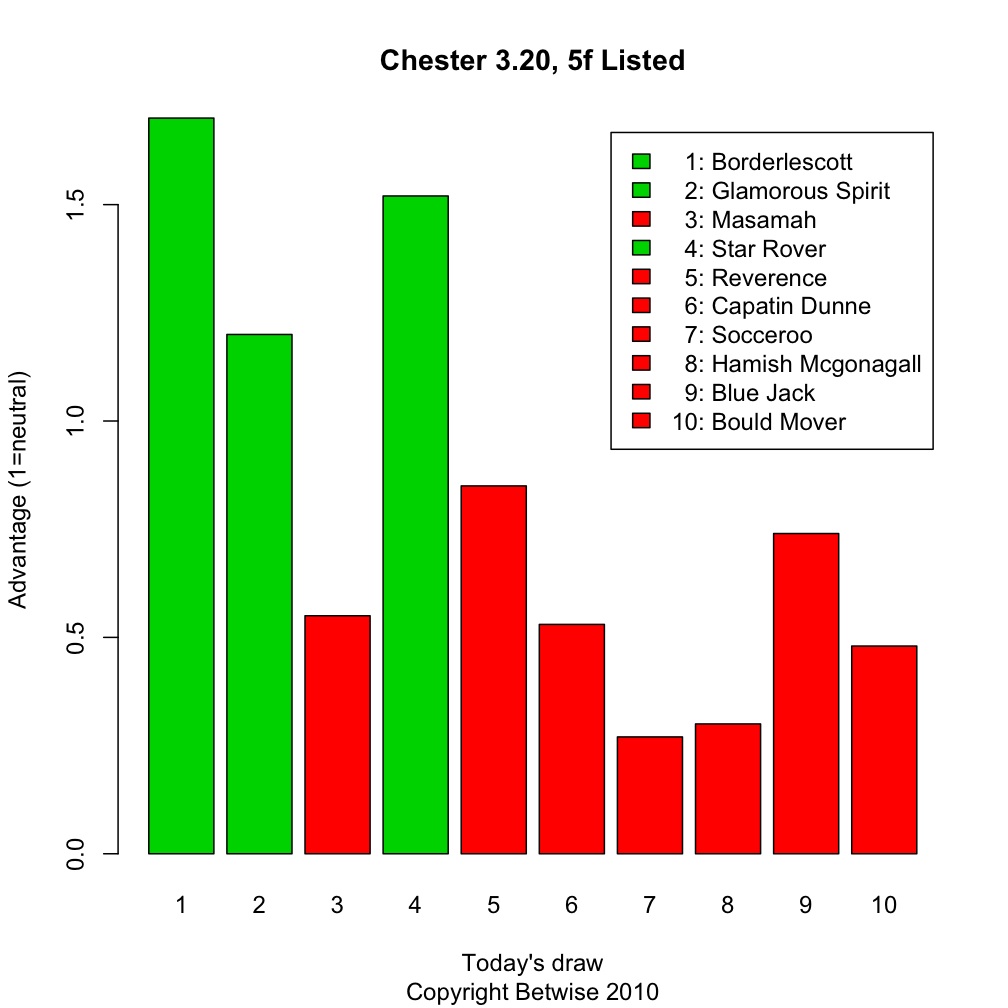
Whilst stall 1 (against the inside rail) comes out best over field sizes of 10, the advantage is not as pronounced as in larger fields, and, ability aside, does not reflect the current price differential between Borderlescott and Glamorous Spirit, drawn just to its outside. Now, which of the two has a better chance of breaking early? Head over to the Betwise Members’ area and find out.
Draw analysis at Sandown today
Saturday, July 3rd, 2010As per last Saturday’s post we shift our attention in July to assessing the effect of the draw in upcoming races. To do this we are using an automated model created with Smartform, applying the principles laid out in the Betwise article in this month’s Racing Ahead.
Focus today is on the first race at Sandown, which requires analysis of the 5 furlong straight course in the middle of the track. As with front runners, draw bias tends to show up in results most strongly at races under a mile. Although there are notable exceptions to this rule (as with the case of the Ebor draw bias over 1 mile 6 furlongs at York), it usually pays to concentrate on sprint distances.
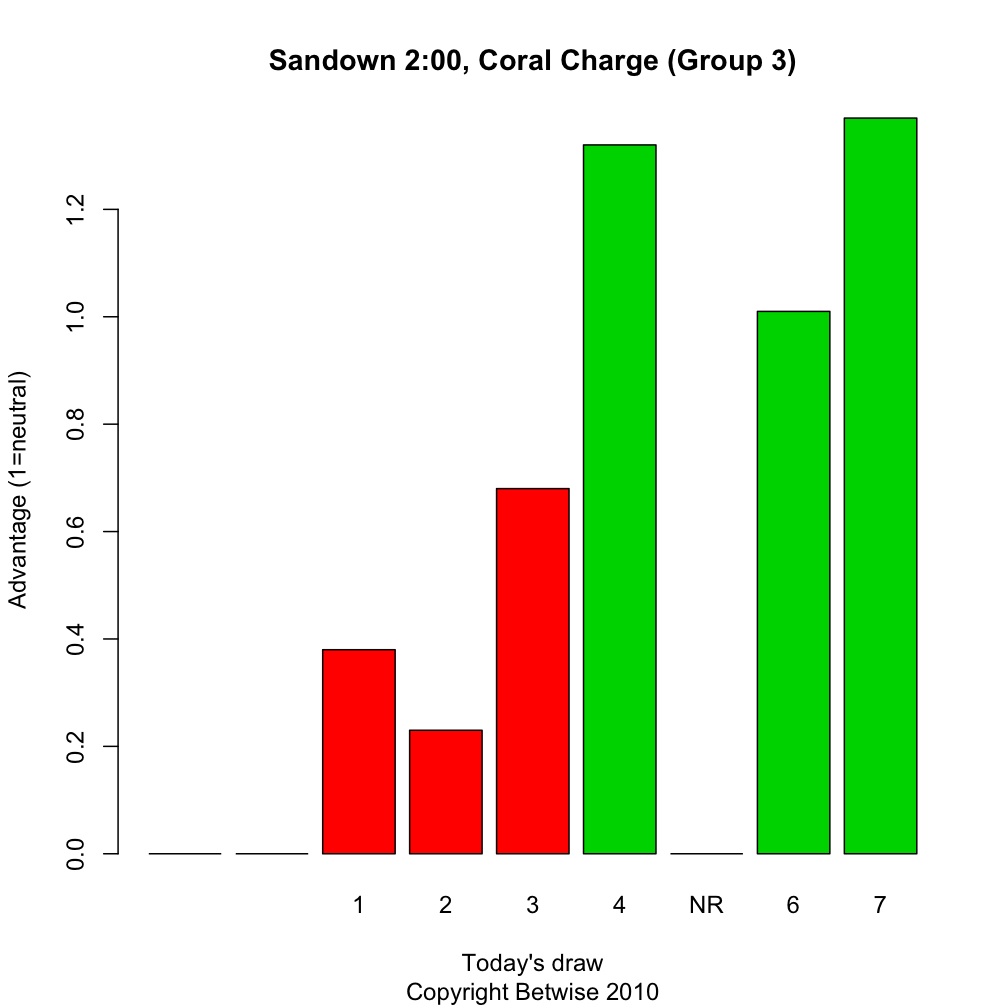
Sandown exposes a weakness in some draw analysis you can find, which is to concentrate on strike rate per stall, without factoring in stall positions. You can read a lot more about this in our article, but sticking with the case of Sandown, as any regular Sandown racegoer knows, the stalls are usually positioned with the highest number against the far rail and represent a position – though not necessarily a stall! – that has held a continuing advantage over the years. The actual stall number drawn against the far rail varies according to the size of the field, making strike rate per stall statistics more or less redundant. The way to overcome this is to use historic data to map the advantage of the position on the track which each stall occupied (though even here, there are always problems presented by rail movements).
Our Smartform model above maps the previous advantage of each course position onto all today’s stall numbers, as if you are looking overhead at the race about to start – stall 7 is drawn against the far rail. The height of the bar represents stall advantage, with anything over 1 indicating higher than expected winners and under 1 a negative expectation. (Stall 5 should be empty today due to the withdrawal of Wi Dud – draw 4 may be shifted one up as a result).
What conclusions to draw from this? Though we can see immediately that the draw advantage in small fields does not exclude the possibility of any runner winning, there is a distinct negative from being drawn in stalls 1, 2 and 3. Combined with front runner analysis, we can also see which, if any, of these contenders are able to break early to secure a better position (front runner analysis for this race is posted in the Betwise Members’ area and freely available). Going back to the commonly held belief that the highest stall is the place to be at Sandown, we can see that whilst this is born out by our Smartform model, it is very marginal for small fields, and there is, for example, almost as big an advantage being drawn in stall 4 today. So is Bould Mover, in stall 4, better value than Triple Aspect, the hot favourite drawn on the far rail in stall 7? Does Reignier, in stall 3, represent value at 14/1, given that stall 3 still produces a reasonable number of winners in small fields? Of course, answering these questions relies on far more than knowing the runners’ stall position – we need to know more about the ability of the horses concerned, but at least we can now put the effect of the draw in its place.
Who will make the running in the big sprint at Sandown?
Saturday, June 12th, 2010Today’s front runner analysis using our Smartform model focuses on the richest race on the card at Sandown – the listed Scurry Stakes over 5 furlongs, due off at 3.30 and worth over 22K to the winner alone.
Without further ado, here are the results of today’s leader analysis for this race (percentage ranked chance of leading early, followed by stall positions):
Burning Thread, 0.27, 9
Above Limits, 0.21, 2
Red Avalanche, 0.16, 6
Duchess Dora, 0.12, 3
Reignier, 0.12, 1
Lady Brickhouse, 0.06, 5
Tawaabb, 0.06, 8
Duplicity, 0.00, 7
Diamond Johnny G, 0.00, 4
The usual caveats apply to the raw numbers – there is no measure of ability, suitability to conditions, or any individual measure of form (other than analysis of the previous running style of each contender) used in the production of the ratings.
Another caveat is that today’s race includes runners with little historic form, being limited to 3 year old competitors. This last observation applies especially to our top ranked leading contender – Burning Thread. He’s had only 3 runs in total and was slowly away on the first of them, meaning he also scores as a potential lagger. However, we’re prepared to forgive his debut run last year, since his last 2 outings show him to be a useful, pacey sort.
As we look at the next factor of interest from a pace perspective – the draw – another positive for Burning Thread emerges, in that he is drawn in stall 9 (of 9). Traditionally the draw at Sandown on the 5 furlong track in the middle of the course favours those drawn against the far running rail. Relying on a so-called “known” draw bias can be suspect (unless the reason such bias is hard to counter as at our favoured example of the inside rail at Chester) especially as clerks of the course may seek to mitigate such advantage on straight courses through watering policies and the like. In such cases it pays to look at recent evidence in the draw, something we’ll be focusing on as a topic in its own right over the coming months. For the case in hand at Sandown today, we will assume that the rail draw is no negative, and may well provide extra assistance, despite the field size being relatively small.
Let’s say Burning Thread takes a prominent racing position from the rail draw – is he good enough to win? That is more doubtful. His ability ratings are not the best in the field, and in this class he may face stiff competition in the closing stages. If the favourite, Duchess Dora, is close up (as befits her running style), he will be in danger. There may be a back to lay opportunity, as his price currently stands at 5.3 on Betfair (as of the time of writing, at 9 am), which should be shorter if he is a genuine contender within the final furlong. At a much bigger price, 12.0, Red Avalanche is also interesting in stall 6 – but we have to take on trust his comparative ability as a 3 yr old since he has been off the track for 245 days. Whilst he also raced keenly as a juvenile, we cannot really predict what his running style may be without more recent evidence. All in all, this a tricky affair with so many unknowns to factor – but, of course, that’s one of the things that makes racing fun.
Chester May Festival – the draw revisited
Wednesday, May 12th, 2010The draw bias at Chester racecourse, particularly over sprint distances, is a favourite example trend, simply because it is so pronounced when analyzed quantitatively.
Blindly backing any horse drawn in stall 1 and stall 2 in sprint races (defined as being over 5 and 6 furlongs) in larger fields (over 10 runners) has produced a consistent profit at starting price (and even more at Betfair SP) over the past few years. Even in smaller fields and over longer distances, the first starting point for analyzing races at Chester should be the draw, though it’s always worth revisiting any assumption, especially when there is new information.
Last week at Chester, there were only 2 races qualifying with a larger number of runners (10+) over minimum distances. For stalls drawn 1 and 2 these fared as follows:
+---------------------+----------------+-------+------+-------------+--------+

| scheduled_time      | winner         | stall | SP   | num_runners |  result |

+---------------------+----------------+-------+------+-------------+--------+

| 2010-05-05 15:15:00 | Look Busy      |     2 | 9.00 |          13  |      4 |

| 2010-05-05 15:15:00 | Royal Intruder |     1 | 8.00 |          13  |      7 |

| 2010-05-06 16:30:00 | Tasmeem        |     1 | 9.00 |          11  |      5 |

| 2010-05-06 16:30:00 | Rule Of Nature |     2 | 3.00 |          11  |      2 |

+---------------------+----------------+-------+------+-------------+--------+
The best result any one of these could manage was second – and that was for the Michael Stoute trained Rule of Nature, which went off at a short price indeed and should have had a lot more going for its chances than the draw alone.
If we extend our survey to 7 furlong races, we find one more qualifier which produces a winner as follows:
+----------+---------------------+-----------------+-------+-------+-------------+--------+

| distance | scheduled_time           | winner                   | stall | SP       | num_runners | result |

+----------+---------------------+-----------------+-------+-------+-------------+--------+

|     1100     | 2010-05-05 15:15:00 | Look Busy             |     2     |  9.00  |          13          |      4      |

|     1100     | 2010-05-05 15:15:00 | Royal Intruder   |     1     |  8.00  |          13          |      7      |

|     1320     | 2010-05-06 16:30:00 | Tasmeem                 |     1     |  9.00  |          11          |      5      |

|     1320     | 2010-05-06 16:30:00 | Rule Of Nature   |     2     |  3.00  |          11          |      2      |

|     1540     | 2010-05-07 16:30:00 | Lucky Numbers     |     1     |  5.50  |          12          |      3      |

|     1540     | 2010-05-07 16:30:00 | Dance And Dance |     2     | 11.00 |          12          |      1      |

+----------+---------------------+-----------------+-------+-------+-------------+--------+
Just the one winner from the extra 7 furlong race produces sufficient returns, even at SP, to cover blind faith in the draw advantage alone, but clearly more analysis is needed, even at Chester. Whilst it is obvious to anyone who has seen the Roodee that the draw advantage gives a significant edge to any runner racing on towards the inside rail, there are other factors as well as the draw at work to enable runners to get to the inside rail – and to secure that advantage. Not least is the ability of a horse to break and lead early. Whilst the effects of the draw are important, the proportion of front runners who win sprint races is equally compelling as we discuss in our analysis of front runners in this month’s Racing Ahead. Combine a front runner at Chester with any stall position that gives it the ability to cross to the rail early, and you have a powerful combination to give that horse a winning edge – especially, in the case of stall position, if the horses drawn on the inside are less capable front runners. So what did win the two larger field sprints at Chester last week?
+---------------------+-------------+-------+-------+-------------+--------+

| scheduled_time      | winner      | stall | SP    | num_runners | result |

+---------------------+-------------+-------+-------+-------------+--------+

| 2010-05-05 15:15:00 | Masamah     |     3 | 10.00 |          13 |      1 |

| 2010-05-06 16:30:00 | Horseradish |     6 |  3.75 |          11 |      1 |

+---------------------+-------------+-------+-------+-------------+--------+
Masamah still had an excellent draw in stall 3, a history of running from the front, and indeed ran as follows:
made all, ridden over 1f out, stayed on well final furlong
a running style that fits the hypothesis well.
In the case of Horseradish, he raced on softer ground than normal, and was able to track the leaders and still win, as follows:
tracked leaders, headway to lead over 1f out, ridden and stayed on well final furlong
Clearly relative ability will always enable horses to win races whatever their draw, though being drawn 6 of 11 on softer ground was not a huge disadvantage.
We’ll be using the Smartform database to produce more analyis of this sort over the coming months, which combines both in-running styles and draw analysis.
Finding winners automatically
Thursday, April 29th, 2010Automating the betting process was possible for some time before the emergence of the Betfair API and writing Automatic Exchange Betting, but making the process reliable was a challenge. Betfair’s API created a robust way to programmatically access market data and place bets via the exchange (as opposed to a web scraping approach), but there was still no good way to automate the selection of bets themselves. This required unreliable and/or manual processes to either export data from one of the traditional interactive racing databases, such as Raceform Interactive, or to write robots to scrape the web from online form sources (which was unsatisfactory for various reasons – grey area of site usage, changing page formats, incomplete data, to name a few).
So, to make the selections part of automating the betting process more robust, Betwise created the Smartform database before publication of the book by licensing copious racing data for Members’ personal use back in 2007, designing it for automated updates from original sources, and making it as easy as possible to create and run programs to do just about any aspect of form analysis and output selections for automated betting; no manual ‘data exports’ necessary.
Along with the Betfair API, the service completed the DIY betting automation picture. For sure, programming is not everyone’s cup of tea, but if a bettor has a manual betting process that can be well described, it is a good candidate for automation since any good betting strategy, automated or otherwise, begins with data.
An example I used in a magazine article just before the book was published illustrated just how simple the principles of automated betting can be. We looked at a straightforward case that can be considered at one particular racecourse to show how even analysis of a single variable could be turned into a useful automated strategy for certain types of races. For a more general approach to all races, of course, it makes sense to look at more sophisticated models for predicting performance which use multiple factors.
Draw and Pace: Chester 2.55, Saturday
Saturday, May 22nd, 2010Today’s Lambs Navy Rum Handicap at Chester is an inauspicious affair – a class 5 handicap worth £4047 to the winner.
However, it’s of particular interest to us because the race throws up a chance to apply the analysis we’ve been looking at recently with regard to draw and pace in sprint races.
Chester is our favourite example for draw bias, and we’ve done lots of research which shows the continued profitability of backing stalls 1 and 2 blind in larger fields over 5 furlongs. In fact, it’s a trend you can make an automatic profit with over the long run, since it is usually underbet – though of course the prices that make this true can change in future.
What will not change is the natural advantage handed to horses drawn low. As we saw earlier in the month at the May festival, an analysis of front runners can also help determine who will get to the rail early and stay there. Speedy sorts can overcome the natural advantage of stalls 1 and 2 by beating those runners to the rail – as in the case of Masamah who made all to win from stall 3 in a 5 furlong sprint at the May festival – though we won’t bother to look at anything drawn higher than halfway in this 12-runner field, so we discount anything higher than 6.
Betwise use a front runner prediction method derived from in-running comments in the Smartform database, that we will be describing in detail in the June edition of Racing Ahead. Applying this method to the 2.55 today, our top 6 (in order) for those most likely to break early and lead from the front are:
Of those drawn in the top 6, only Memphis Man (drawn 2) and Radiator Rooney (drawn 6) do not make the cut as previous front runners that rank as likely to lead, though no doubt their jockeys will/ should do everything to encourage them. Red Rosanna and Baby Queen, despite being in our top 6 ranked front runners, will be discounted since they are both drawn higher than 6. Which leaves us with a shortlist of 4 – Not My Choice, Harry Up, Legal Eagle and Sir Geoffrey in the 12 runner field, before looking at any individual horse’s recent form or ability.
We still think that draw is the most important factor at Chester (meaning we’d be reluctant to go against Not My Choice in stall 1), though the top ranked front running ability of Harry Up may be enough to overcome his poorer draw in stall 5. At this point in the game it’s time for individual choice and weighing up each horse’s potential to win against its price (at prices of 7.6 and 8.8 for the two horses mentioned, you can make a reasonable argument for value already). Whatever the individual bettor’s view, discounting over 60% of the field makes that task much easier.
Tags: Chester, draw advantage, front runners, Harry Up, in race comments, Not My Choice, pace, Smartform
| No Comments »